
MG/YA Book Reviews by a MG/YA Author
Table of Contents
Author News
MG/YA Book Reviews
In the Garden
Author News
Welcome to the October edition of Bookcase Bizarro!

As AI panic continues to reign in the publishing world, I have reluctantly decided it’s time for me to draft my own AI policy so that readers can decide for themselves whether or not to support my work. I am in the process of doing so. Here is my thinking so far:
Full disclosure: I do not use AI to write any part of my books or blog newsletter. Nor do I use it to write emails, or draft marketing copy (though this may change in the future). I use a spell-checker and an AI alt text generator inside WordPress for my newsletter. I have used AI to make suggestions for a dust jacket blurb, but I wrote the initial copy myself. I found it very useful for giving me a framework for revision. I then rewrote the blurb and sent that revision to my human editor for a final critique.
Speaking of editors, I use three human editors and a human book cover designer for each book, and I approve each revision/design. I view my relationship with my editors as an essential part of my writing development, so for me, it’s well worth the investment. My book cover designer brings a unique artistic sensibility and creative perspective to each book that a machine alone could not replicate. I have no plans to replace either my book editors or book cover designer with an AI. Ever.
I am leery of handing tasks over to an AI because of the potentially negative impact these technologies could have on my own cognitive abilities. Struggle and fallow time may well be a fundamental part of creativity, part of what gives an idea and the subsequent creative work its distinctly human stamp. I’m not interested in shortchanging that process, or robbing my mind of the practice it needs to do its work. That’s a personal decision, not a moral directive. Plenty of other writers have said that working with AI fuels their creativity. I believe them. It’s just not for me.
I’m definitely not comfortable feeding my books into an LLM, which I understand is how you get the best, most targeted interactions. I don’t mind feeding my marketing copy into them, and I anticipate that marketing is mostly what I’ll use AI for. I may also use AI for analysis as my business grows. I do use it for research, but I’m careful to check sources, and I think of it more as a starting point for deeper inquiry. I prefer to do my own bookkeeping and financial management.
In short, I view AI as a tool that I use in my writing business, but not in my actual writing.
Of course, you are going to have to take all of this on trust. I can’t prove what I say is true. Someone may very well come along and feed my books into an AI-detection tool and accuse me of AI use because of my love of em dashes—I’m not giving them up—or (fill in the blanks). Who will you believe?
Right now, authors accused of using AI are being pilloried without due process, and are being asked to share drafts of their work to prove their innocence. The demand that writers give up private files never intended for public consumption is to me every bit as abhorrent as the accusations. Meanwhile, the editors, publishers, and contest judges who have supposedly vetted these works are not being asked to provide similar proofs that they’ve done their job, and instead are given a free pass. It begs the question: If they, the professionals, can’t detect AI use without the aid of a machine (like Pangram), then what is their taste or judgement worth? Clearly, the stories are good enough to win prizes, which means that a human writer skilled in writing craft was involved in their making. (AI is not good at writing fiction by itself.)

Maybe it’s time to accept the fact that in the hands of a skilled writer, AI can assist in creating good work that people want to read, similar to the good work produced by an AI-minimal writer, like myself.* Both approaches take creative effort and vision. AI assistance is as valid a creative choice as my own decision not to use AI in any part of my writing process. And who knows? If my long COVID-induced brain fog ever came back, I might choose AI assistance rather than suffer through the despair of not writing. Would that be a bad choice?
Writers should be free to choose their own tools to do their work, including AI, without being scapegoated for choices others make with impunity, like the publishing industry. Forcing writers to turn over private drafts or face exclusion from conferences, organizations, contests or contracts, while leaving it up to a machine to decide who is a true writer, is draconian, intrusive and dangerous. Are we really prepared to outsource our trust to an AI-detection software owned by a private corporation?
Readers are free to choose to believe authors or not when they self-disclose, as well as make up their own minds about whether they want to read the work of a particular author (or not). I don’t think that anyone has the right to doxx, accuse or harass anyone for using AI. And do we really want to reduce reading to a way of “unmasking” authors who may (or may not) have used AI? Seems like a spectacularly joyless activity to me, not to mention the harm it causes the entire bookish community. Anti-AI extremism will only turn people away from books and reading. Why subject readers to a toxic climate of unfounded accusation, guilt and condemnation that leaves them feeling duped and guilty? For READING.
Think about it.
Even though I don’t use AI in my own writing, I stand with all writers who use the tools in ethically responsible ways. (See Alli: The Alliance of Independent Author’s definition here.) I have greatly enjoyed books by AI-assisted authors, like Joanna Penn, and expect to enjoy many more in the future. I expect to be beaten by an author who uses AI in the contests I enter, and would accept that with as much grace as I would if I lost to an author who didn’t. To me, there is no difference.
*To be clear, I’m not talking about books completely generated by AI or writers who use AI-generated text without editing, both of which are highly problematic.
This month’s book has nothing to do with cats. It’s October, so of course we’re going all in on amusement parks, which I have always found a bit creepy. And sad. Join us as we run amok in a family-owned amusement park, where the fairy tale creature rides are … changing.
A quick note to new readers: books that are available from the Toronto Public Library will be marked #TPL, because books don’t have to be new or owned in order to be loved.
MG/YA Book Reviews

Nobody understands why the Whisperwood amusement park has shut down. Its picturesque setting in the Appalachian foothills, with thrilling rides based on Wilhem Strauss’ Whisperwood fairy tales, has attracted fans from all over the world. That all ends when Victoria Strauss, the family’s reigning matriarch, permanently shutters with park with no explanation.
Even Frankie, Victoria’s granddaughter, can’t fathom why her Oma would do such a thing. Before Frankie can screw up the courage to ask, Oma disappears. That doesn’t stop the Strauss family from fighting about who should take charge of the park and the family’s dwindling fortunes. Frankie wants nothing to do with her dysfunctional family’s squabbles, but suspects there is more to Oma’s disappearance than meets the eye. And the answer may lie in Whisperwood Park itself, where family lies and fractured fairy tales threaten to entangle Frankie in a deadly web of deceit and betrayal.
I enjoyed Jo Schulte’s debut novel for its sheer inventiveness and the scope of what she was trying to pull off. Her portrayal of a decaying amusement park owned by a screwed-up legacy family is satisfyingly atmospheric. The park itself is based on a series of famous fairy tales written by the family’s founder, Wilhelm Strauss, and the book is peppered with these original tales, a book-within-a-book. Schulte knows and understands the language of fairy tales, so each one of these is a small gem—a monumental feat for a debut author. (In fact, the book is worth reading for the fairy tales alone.)
The fairy tales introduce readers into the world of the Whisperwood, and function as plot and backstory devices. I wasn’t always able to draw parallels between the tales and what was happening in the book, and would have appreciated some more concrete connections. Also, far too much backstory is explained in one tale instead of being integrated into the plot. (Of course, other more famous writers are notoriously guilty of doing exactly this—J. K. Rowling, anyone?) Layering the present story line with fairy tales and frequent flashbacks created a fractured sense of pacing, even though both were necessary plot devices. I wondered if this was a case of an author trying to do too much with one book?
Without introducing any spoilers, the book’s magic system was not at all clear to me, particularly the relationship between the family, the amusement park rides, the magical creatures, and Magic itself, which appears as a kind of entity. It’s a very complicated mixture of dysfunctional dynamics that go back generations, fractured fairy tales, corrupted magic that bleeds into real life, and the power and dangers of creativity, all wrapped in a haunted setting. By the end of the book, I was still reeling, and didn’t really have a good grasp of how everything worked.
Schulte is a real wordsmith, but like all wordsmiths, she sometimes falls in love with the sound of her own language rather than asking what purpose they serve the story. A lot of the metaphors are Voice-y and highlight Frankie’s character and perspective, but their impact is diluted by overuse. However, Schulte is a talented writer who will doubtless hone her writing gifts to a magnificent sharpness as time goes on.
I would love to be able to discuss the ending, but won’t beyond this one point: I can see what Schulte was trying to accomplish (and I loved it), but mechanical problems make the conclusion improbable for me.
Frankie herself is a complicated main character. Some readers have had a problem with that. I didn’t, but again, the mechanics of memory and forgetting that the story plays with needed more development, and I would argue that it could have been done most effectively with Frankie and Oma, who is little more than a shadowy figure in the book before she goes missing. I couldn’t help feeling that the emotional core of the story might have been better served with Frankie and Oma, and their fractured relationship, at the center, rather than a love story. Still, I really appreciated the scope of what Schultz was trying to achieve, even if it wasn’t seamlessly executed.
A high-concept, amusement park horror fantasy novel, aimed at upper MG-to-YA readers. There is some fairly clean romance included. (#TPL)
In the Garden
I’ve fallen WAAYY behind on gardening. I’d meant to get more lettuce transplants in, but that seems quite beyond my capabilities at the moment. Luckily, I managed to do some autumn plantings before Spinoza came into our lives, so all is not lost.
After misjudging watering needs (again), I got myself a moisture meter, and am religiously using that with good results. I don’t know how many times I’ve heard this advice: “Put your finger into the soil for about two inches. If it feels dry, water.” This has been exactly the wrong approach for my indoor plants, where the first two inches of soil may be dry, but four inches down and further (i.e. where the root ball sits), moisture levels may be just fine. This is the level the moisture reader reaches and measures at. Watering the soil’s dry surface may super-saturate the deeper levels of soil, which explains the death of three of my lettuce plants due to over-watering.
The other challenge I am having is how to properly plan successions. I can’t follow the standard advice, which is to plant a new crop every two weeks, because I don’t have any places to put the new plants. All my containers are full of plants. I have to replace finished or “spent” plants instead.
To do that, I calculate backwards from the plant’s expected lifespan. My lettuce varieties mature in a little over a month, and they can be harvested as much as three times after the initial harvest. I can extend that window if I only harvest mature leaves and let new ones grow. Harvests occur bi-monthly or weekly, depending on how fast the plant is growing. My indoor plants grew more slowly over the winter than they did in the spring. So I’ve determined that I should start new seeds after the first or second harvest (depending on plant growth). Transplants can remain in their large cell pack for up to a month, which is basically two harvest cycles, so I should have a healthy young plant ready to transplant just as an older plant expires. I will probably test out both first and second harvest plantings to see which one does better.
Of course, this assumes I will actually find the time to start those seeds and transplant those plants. Only Spinoza knows.


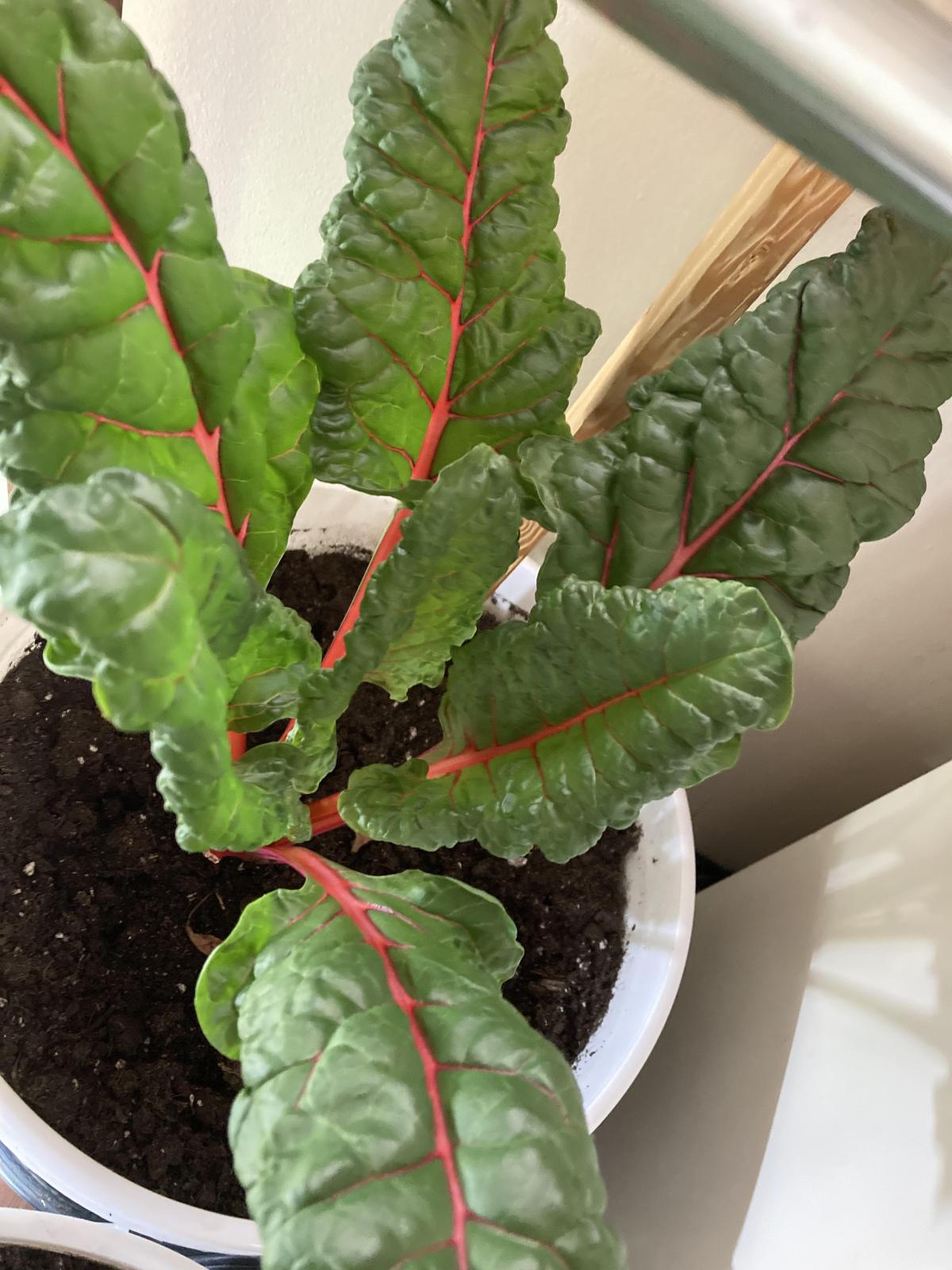


From L-R, T-B
Lettuce transplants, Black Seeded Simpson lettuce, Improved Rhubard Swiss chard, arugula, Lolla Rossa lettuce seedling, garden cat.


Thirteen-year-old Ermin is a gifted mechanic and the worst student at St. Anselm’s Training School for Orphans. She’s just failed her exams for the third time—something nobody’s ever done. Worse, Ermin’s been running her own repair business for money—something that’s expressly forbidden. If the headmistress finds out, Ermin will go to prison. Her future will be over before it’s even begun.
But that’s not her only secret.
Her best friends, Colin and Georgie, are wizards in a world where magic is strictly controlled. Ermin worries that her friends will be captured, drained of their power, then banished. When Georgie’s caught aiding the Wizard’s Resistance, Ermin repairs a broken flying carpet so all three of them can escape.
Hesitant to join the Resistance because of her lack of magical power, Ermin steals an experimental device from a wizard hunter that could destroy every wizard in the Creek. She’s faced with a choice: either smash the device or convert it into a different kind of weapon—one that not only helps wizards but just might get her an apprenticeship at the prestigious Guild Academy.
Ermin’s got one chance to get it right. If she fails, she risks losing her two best friends… and her dreams.
Find Shadow Apprentice at your local library, bookstore, or favourite online retailer.
Do you know about ALLi: The Alliance of Independent Authors?
If not, maybe you should!
Formed in 2012 as a global non-profit organization for self-published authors, ALLi offers a comprehensive bank of educational resources on all things self-publishing, including a free blog and podcast, which de-mystified the entire book-making, publishing and marketing process for me.
While I’m a member of ALLi, I’m also an affiliate. If you’re interested in joining ALLi, please consider using my affiliate link. it will cost you nothing, and will help offset the cost of my yearly membership fee. (You can also click on the ALLi graphic in the sidebar.)
Thanks for being a Bookcase Bizarro reader! I’ll be back next month with more author news, and more MG and YA book reviews. See you then!
Check out Greg Pattridge’s weekly MG blog hop MMGM every Monday at his website, Always in the Middle.
