
MG/YA Book Reviews by a MG/YA Author
Table of Contents
Author News
MG/YA Book Reviews
In the Garden
Author News
Welcome to the September edition of Bookcase Bizarro!
I apologize for being late with my newsletter this month. The reason is shown in the photo on the right. We have a new kitten at our house!

It wasn’t planned. It happened at the worst of times. And it’s completely upended our lives. Here’s the story …
My partner, Allison, and I, were vacationing at a farm near Tweed, Ontario. We were driving along a country highway. Fields zipped past, their outlines blurred by the fast-fading golden light. Up ahead lay a farmer’s vegetable cart that we usually stopped at to stock up on produce. There wasn’t much left, but we unearthed some potatoes, squash and garlic. Just as we were putting our money into the strongbox, a little grey cat walked out from under the cart, sizing us up with wary interest. Allison crouched down. The cat came to her. He was no more than a kitten, maybe 8 weeks old, too thin for his age and without a mother cat in sight. Maybe he had wandered down the road of a neighbouring farm?
I offered to go to the farm myself to check while Allison waited with the kitten, but the kitten had other ideas and started off down the road after me. I scooped him up, feeling his fragile, bird-like bones through his soft fur, terrified that he would somehow get loose and cross the road. Then he squirmed and clawed his way out of my arms and did exactly what I’d most feared. Allison rushed across the road after him. As the kitten beelined for a dense patch of brush, Allison thought it was over. Once he disappeared into the brush, we’d never find him again. Instead, the kitten turned to her and let out a plaintive mew. Allison crouched down, coaxing him to her, and when she scooped him up, he immediately fell asleep in her arms.
That should have told us everything we needed to know, but at that point, we were still talking about cat rescues and shelters. There was no question in our minds that we had to take him with us. We couldn’t leave him near the road to be killed by a car or a nighttime predator. We loaded him into the car, wondering how on earth we were going to feed him. The stores were all closed. Then Allison thought of a friend of a friend named Will, who lived a little way down the road. With Allison cradling the sleeping cat, I drove down the road to Will’s house, parked, and walked up to his front door. Inside the house, a dog barked. I saw a man with close-cropped hair peering out. Will didn’t know me, so I quickly introduced myself and gestured to Allison, who emerged, still cradling the kitten. As we explained the situation, Will’s face broke into a gentle smile.
“I got you.”

While Will moved around his kitchen, gathering supplies, our relief was palpable. The kitten might be asleep now, but when he awoke, he would be hungry. Thanks to Will, we now had enough food to feed him. Will was not surprised we’d found the cat along this particular stretch of road. According to him, it had become a dumping ground for unwanted animals. Will had rescued several himself, including a dog who’d been left howling its heart out on a minus 27C degree night last winter.
As we drove back to the farm, our minds could barely take in the juxtaposition of such cruelty with Will’s kindness, both occurring within a few short meters of each other.
Back at the farm, we set up food bowls and a litter box, and took turns cuddling the cat. We were amazed at how comfortable he was with us, considering the cruel abandonment he’d recently endured. We reminded ourselves that we had to call the shelters. The next day, as I drove into town for kitten supplies, the thought of giving him up so overcame me that I had to pull over to the side of the road to calm down. I had a deep, inner knowing, akin to an ache, that if we gave up this cat—even to a good home—we’d deeply regret it. Only a month ago, Allison had asked me how I felt about getting a cat. I’d given her a hard ‘no.’ Now here I was, completely reversing my position!
It was the worst time to take in a cat. Our home was hardly kitten-proof, and we’d recently completed a major home repair and reorganization. We were bone-tired, especially Allison. We’d been looking forward to this vacation as a chance to relax and recharge before the busy autumn. Now, our plans had been completely hijacked by this cute little ball of fluff. Rather than relaxing, we were being thrown back into a fresh round of chaos—and work. Were we really prepared to deal with the complete re-orientation of our lives and routines that caring for a kitten would entail?
Short answer: No. We were not prepared. But a bit of research revealed that nearby shelters and rescue operations were completely overrun with unwanted animals and kittens that were every bit as cute as the one we’d found. How good would our kitten’s chances of adoption be? The heart-wrenching clincher was that this little cat had bonded with us every bit as much as we had bonded with him. What would surrendering him do to his burgeoning sense of love and trust? What would it do to us? It was not to be borne. Like it or not, this little guy had claimed us. The Cat Distribution System had spoken.
I once vowed I would never post any cute cat pictures on my website. Now, I have posted two. It just goes to show that Rachel Lynde (of Anne of Green Gables fame) was right when she said:
“You’re never safe from surprises until you’re dead!”
This month, we meet two young Black man who’ve been accepted into prestigious schools (one in the 1960s, the other in the 1990s), who wonder whether the vision of “success” these institutions promote is worth the price it extracts from them, even when their parents have sacrificed everything to get them there.
A quick note to new readers: books that are available from the Toronto Public Library will be marked #TPL, because books don’t have to be new or owned in order to be loved.
MG/YA Book Reviews

Gibran Wilson has received a scholarship to Howard University, but first he has to graduate from Lakeside Academy. The year is 1995. It’s becoming harder and harder to stomach the many subtle and not-so-subtle racist attitudes directed towards Black students and incidents that the school’s administration turns a blind eye to. When Gibran’s request to attend the Million Man March with other Black students is criticized and turned down, it’s the final straw. Gibran writes an open letter about racism at the school, only to have it ignored while white students’ feelings get prioritized. Gibran’s mother, Dawn, tells Gibran to focus only on graduating, but Gibran can’t close his eyes to injustice, and going along to get along isn’t in his nature. As Gibran challenges and questions the school’s authority, and speaks out against racist attacks and microaggressions, he’s increasingly marginalized and labeled a troublemaker not only by the school but by the other Black students. It isn’t long before he’s given a choice: either fall into line or lose his place at Lakeside, and his only chance at a university scholarship. Except that giving in feels like giving up—on himself.
In 1968, Kevin Wilson and his fellow students join a sit-in at Columbia University to protest the university’s expansion into an adjacent Black neighbourhood of Morningside Heights in Harlem to build a gym. Then Dr. Martin Luther King is assassinated, pushing Kevin to interrogate the non-violent methods Dr. King and his followers (including Kevin’s parents) espoused. When Kevin hears Malcolm X speak, he is galvanized by the Black Power model of actively fighting injustice through direct action and confrontation, and defending Black people against white violence by any means necessary. But Kevin doesn’t feel entirely at home inside this new movement. Unlike many of the activists and the people who live in Harlem, Kevin comes from the Black middle class. His parents own a home. No one in his family lacks work. His parents are regular voters and can afford to send him to Columbia. He can’t reconcile his privilege with the new ideas he is absorbing, and feels guilty for feeling that there’s m[ore to life than the future his parents have worked so hard to give him.

Kevin and Gibran share a lot of similarities, despite their 30 years’ separation. Both are critically interrogating the power structures of school and society, and their places in it as Black men. Both want to change a world that is systemically unjust and broken. Both of them are acutely aware of the sacrifices their families have made to send them to these schools, and the pressure to live up to other people’s hopes and expectations. The problem is that staying silent and going along to get along seems less like the path to success and more like an act of profound self-erasure that neither of them can stomach.
The book opens at Lakeside Academy in 1995, as three white boys take to the stage during the school’s talent show to “perform” as rappers, with exaggerated movements and inaccurate costumes that turn the skit into a minstrel show. They are not stopped, but are greeted with applause and laughter. When Gibran pulls the plug on the speakers to end the skit, he receives an immediate mark on his disciplinary record. No one asks why he did it. Instead, he is branded a troublemaker.
But is staying silent and playing by the rules any safer?
In 1968, a group of students take over the Dean’s office at Columbia University to protest Columbia’s continuous encroachment into neighbouring Harlem, Kevin is among them. Inside the Dean’s desk, he finds secret files of all the Black students recruited to Columbia with the label “unlikely to succeed” stamped across those who don’t have professional parents or come from “quality” communities. Kevin is shocked when he sees “unlikely to succeed” scrawled across the file of one of the most serious, hard-working, and dedicated students he knows, someone who religiously plays by the rules and stays out of trouble. There is no stamp on Kevin’s own file. His father is a medical doctor. His mother is a housewife. Their home is in a “quality” area. Does that mean white, Kevin wonders? If so, which world is he expected to belong to?
To Kevin and Gibran, the choice between success and standing up for what they believe in is not really a choice at all. Staying silent is no safer than speaking out. They can’t win either way.
This will come as no surprise to BIPOC readers, but Allen goes one step further. She also examines and interrogates white fragility (most particularly at Lakeside Academy) by firmly keeping the story anchored in the lives of her Black characters instead of letting the white characters’ concerns consume attention, as they certainly do at Lakeside. Not only is Gibran’s letter about racism at the school completely ignored by the administration, but the African American History Seminar is taken over by white students expressing their feelings about racism at the school, effectively shutting down and shutting out the Black students. Because of this, the false parallels white people often draw between having difficult discussions and the lived experience of racism BIPOC people endure are shown up as the whitewashing manipulations that they are. It is the book, not the school, that makes a place for Gibran and his fellow Black students.
For me, Allen’s book evoked Mildred D. Taylor’s magnificent Roll of Thunder, Hear My Cry, which I re-read immediately after. I could trace a direct line from the overt, violent white supremacy portrayed in Thunder to the more covert and equally harmful kind operating at both Kevin’s and Gibran’s schools. (Kevin also faces the very real and immediate danger of physical assault or death at the hands of the cops surrounding the school.) The toll it takes on the Black characters is made abundantly clear, but Allen is careful not to let victimization control the narrative. Both Kevin and Gibran are allowed to be the full people they are, in all their complexity—a complexity that Columbia University and Lakeside Academy officials continually try to contain and curtail.
Allen’s also not afraid to tackle male privilege. When a white classmate refers to a fellow Black classmate, Tanya, as a “Black Medusa” because of her braids, Gibran confronts him, speaking for Tanya without her permission. Then Tanya and her friends Lisa and Malika, the head of the Black Students Union, confront Gibran about his letter, which he never consulted them about. Back in 1968, an activist named Valerie checks Kevin for constantly finding fault in everyone and everything, instead of focusing on the work they’re doing with the community in Morningside Heights. Kevin’s black and white thinking, his inability to appreciate that social change isn’t perfect, easy or fast, his constant attempts to control the narrative and his refusal to consider alternative viewpoints alienates Valerie just like it did his sister, Dawn, and the rest of his family.
Dawn is the connector between Kevin and Gibran, and through her, the two stories come together. Dawn does not want her son to follow in her brother’s rigid, uncompromising footsteps, and she’s torn between fear and pride in Gibran’s ability to speak truth to power. While she endlessly reminds Gibran to stay focused on graduation, Gibran remembers a different mother who tried to warn him and his sisters about the new private school they were attending, a school that Dawn got them into because she worked there as a teacher. She told them it didn’t matter if the other kids at White Oaks didn’t like them; they were only there to learn. Don’t trust them, she whispered. Dawn knows the dangers of sending her children to an all-white prestigious school, but she also desires a better future for them, and the opportunities for achieving this are limited.
When Gibran finds a long-lost, unread letter from Kevin tucked inside one of Dawn’s books, he sees a second chance for himself and for Kevin, and for Dawn. Can Gibran learn to fight for himself without shutting his mom and his friends out? Will Kevin take responsibility for all the hurt his constant criticism has caused? Will Dawn learn to trust Gibran’s judgment, especially when it becomes clear that the Lakeside administration has placed a target on his back, and the Black principal is complicit?
Both Kevin’s and Gibran’s stories are equally riveting, which is a hard accomplishment for any writer, let alone a debut writer like Allen. Some reviewers think that Allen’s writing is too utilitarian. I disagree. Allen’s pen may skip over flowery language and metaphors, but her gift shines in the interactions between her richly-developed characters and in her dialogue, and her writing is none the less compelling for it.
Highly recommended for both younger and older teens 14+, who would enjoy a character-driven novel where the action is focused on social, political, and personal change and growth. An excellent companion book for younger readers would be Mildred D. Taylor’s Roll of Thunder, Hear My Cry, which shows the stark horror of the white supremacy that Gibran, Kevin, and Dawn are still fighting against, and why it continues to matter. (#TPL)
In the Garden
Thanks to the Spinoza Disruption, my garden time has been limited. However, the plants seem to be thriving regardless.
I’ve got the first three lettuce successions planted in their outdoor and indoor forever homes, and have one more succession to go. I’m planting leaf lettuces indoors exclusively. The romaines I planted last year definitely grew, but they stayed small under my grow light set-up. Romaines, like spinach, typically need more light than my grow lights supply, which is why I’ve replaced spinach this year with a chard variety called Perpetual Spinach, which grows beautifully indoors. And yes, it tastes remarkably like spinach.
This year marked my return to growing summer crops after a decade’s absence. I (re)learned that sweet peppers take a freakishly long time to ripen. I should have started them on March 1st. Instead, I started them in April, which is why I still have a heavy crop of green peppers. The Jimmy Nardello and Escamillo peppers I grew were healthy and productive, so I will grow them again next year and hope that an earlier start will yield just as heavy a crop of ripe peppers.
Both of my basil plants unfortunately bit the dust. I think a combination of too much water and mulch was the culprit. Next year, I’ll cut back on the watering and I won’t mulch them. Luckily, I got several big harvests from both plants before they conked out.
The shade cloth was a huge success. All the plants continued to grow and produce leaves, or set flowers and fruit, even through the hottest days. (And we had more than a few of them.) Putting it on was easy. Figuring out when to take it off was trickier. After much research, I waited for a string of cloudy days after the UV index had been 8 and under consistently before taking off the cloth. That was in mid-August. The plants sulked a little on the first sunny day, but perked up again in the evening. It took them another day or two to acclimatize to full sun.
Unfortunately, the dreaded squash vine borer completely decimated my one Sunburst summer squash. Oh, well. It was delicious while it lasted. Next year, I’ll grow more callaloo, which LOVES the heat and is a far lower maintenance plant than the mildew-prone, fussy squash. I have no time for drama queens in either the plant or human worlds.


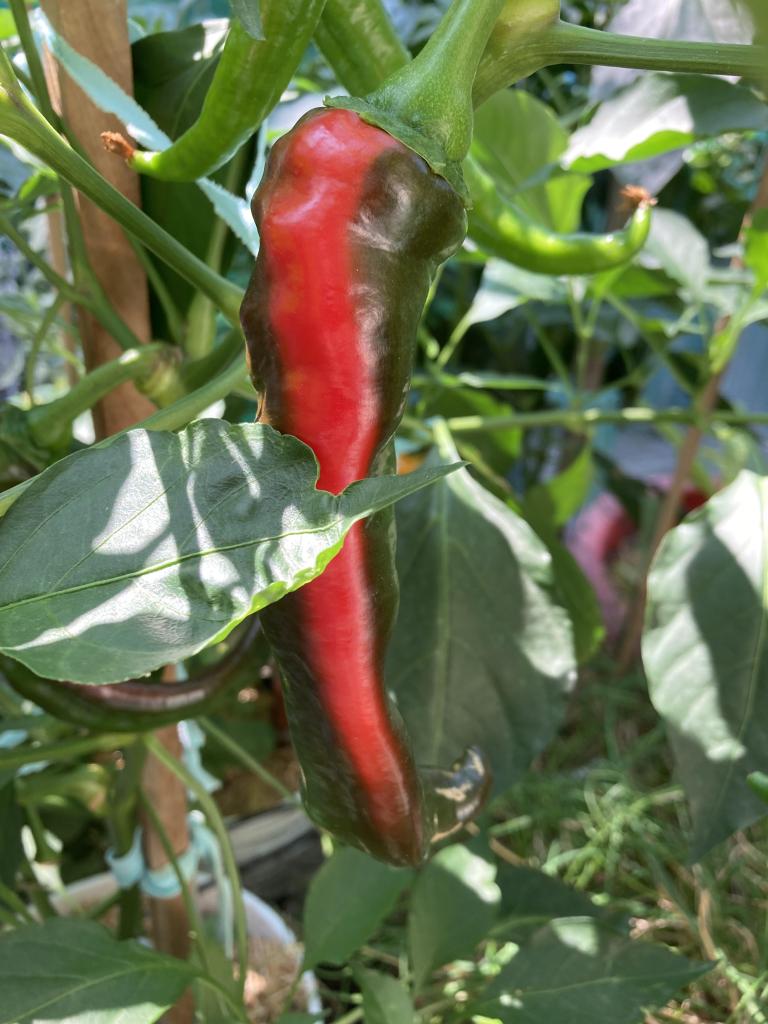

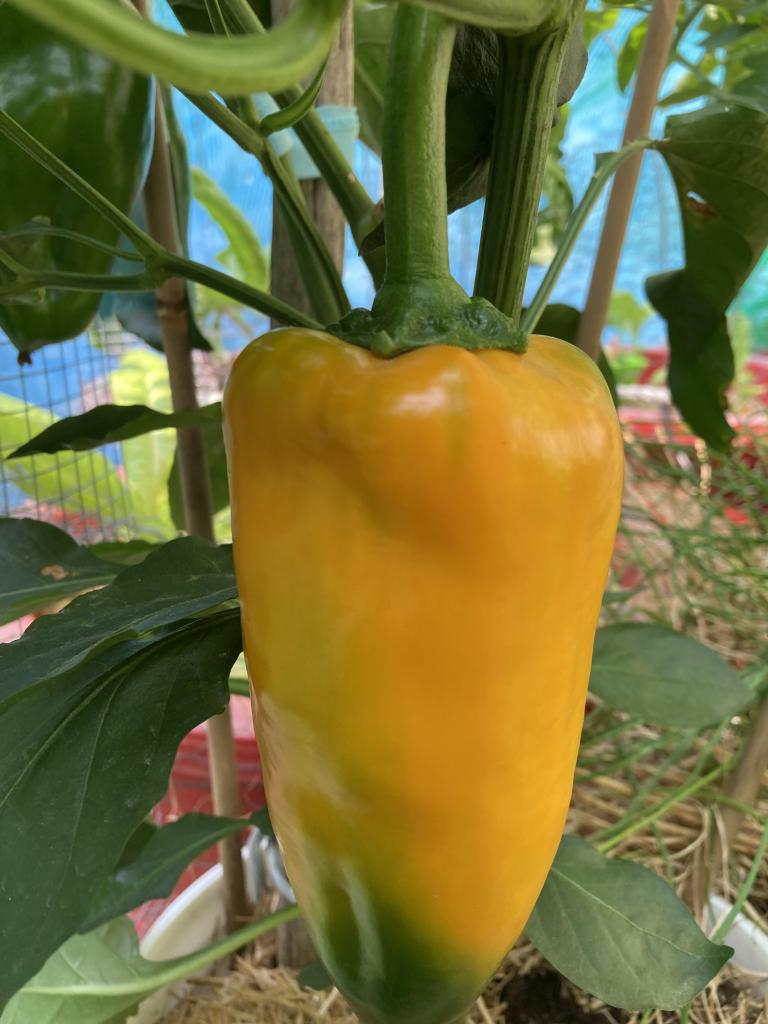
From L-R, T-B
Rouge d’Hiver, Red Fire and Nevada lettuces, Marigold and Sweet Alyssum, dried Principe Borghese Tomatoes, ripening Jimmy Nardello pepper, random beautiful flower, ripening Escamillo Pepper.


Thirteen-year-old Ermin is a gifted mechanic and the worst student at St. Anselm’s Training School for Orphans. She’s just failed her exams for the third time—something nobody’s ever done. Worse, Ermin’s been running her own repair business for money—something that’s expressly forbidden. If the headmistress finds out, Ermin will go to prison. Her future will be over before it’s even begun.
But that’s not her only secret.
Her best friends, Colin and Georgie, are wizards in a world where magic is strictly controlled. Ermin worries that her friends will be captured, drained of their power, then banished. When Georgie’s caught aiding the Wizard’s Resistance, Ermin repairs a broken flying carpet so all three of them can escape.
Hesitant to join the Resistance because of her lack of magical power, Ermin steals an experimental device from a wizard hunter that could destroy every wizard in the Creek. She’s faced with a choice: either smash the device or convert it into a different kind of weapon—one that not only helps wizards but just might get her an apprenticeship at the prestigious Guild Academy.
Ermin’s got one chance to get it right. If she fails, she risks losing her two best friends… and her dreams.
Find Shadow Apprentice at your local library, bookstore, or favourite online retailer.
Do you know about ALLi: The Alliance of Independent Authors?
If not, maybe you should!
Formed in 2012 as a global non-profit organization for self-published authors, ALLi offers a comprehensive bank of educational resources on all things self-publishing, including a free blog and podcast, which de-mystified the entire book-making, publishing and marketing process for me.
While I’m a member of ALLi, I’m also an affiliate. If you’re interested in joining ALLi, please consider using my affiliate link. it will cost you nothing, and will help offset the cost of my yearly membership fee. (You can also click on the ALLi graphic in the sidebar.)
Thanks for being a Bookcase Bizarro reader! I’ll be back next month with more author news, and more MG and YA book reviews. See you then!
Check out Greg Pattridge’s weekly MG blog hop MMGM every Monday at his website, Always in the Middle.
